
Freedom in Surrender
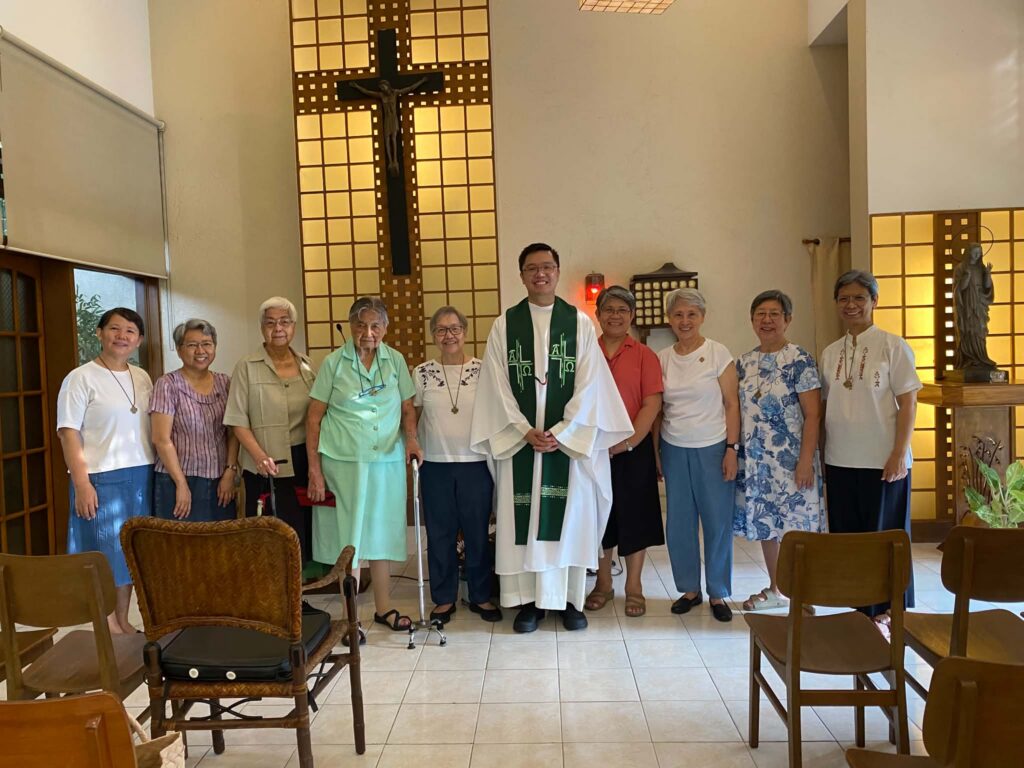
Homily delivered by Fr. Bien Emmanuel C. Cruz, SJ
15 June 2026; Monday of the 11th Sunday of Ordinary Time (1 Kings 21:1-16 and Matthew 5:38-42)
Cenacle Retreat House
My dear brothers and sisters, the Word of God today presents two sharply contrasting visions of the human heart. In the first reading, we encounter King Ahab, who sees Naboth’s vineyard and desires it for himself. He is not in need, yet what belongs to another awakens a desire that quickly becomes entitlement. When Naboth refuses—faithful to his inheritance and to the law of God—Ahab does not accept limitation. His desire turns into resentment, and resentment opens the door to injustice. What begins as wanting ends in the violent taking of what was never his to claim.
This is more than an ancient political story. It is a revelation of the human heart when it forgets God. It is what happens when desire is no longer shaped by gratitude, when power is no longer guided by responsibility, and when possession is no longer restrained by moral limits. It is the logic of grasping: if I want it, I should have it; if I can take it, it is mine.
In the Gospel, Jesus presents a radically different horizon. “Turn the other cheek.” “Give to the one who asks of you.” These are not calls to passivity or weakness. They reveal a deeper strength—the freedom of one who is no longer ruled by the need to dominate, retaliate, or control outcomes. The disciple of Christ is not powerless, but free: free from revenge, free from the anxiety of possession, free from the need to settle every wrong by force or repayment.
Both readings place before us a fundamental question: what kind of person are we becoming in the face of desire and injury? Do we become like Ahab—consumed by what we lack and willing to overstep moral boundaries to obtain it? Or do we become like the disciple Jesus envisions—rooted in trust, capable of generosity, and free enough to step outside the cycle of grasping and retaliation?
The world teaches a different grammar. It tells us that life is secured through accumulation: more possessions, more achievements, more control over the future. It tells us that relationships are governed by exchange: I give so that I may receive, I help so that I may be helped, I forgive if it is deserved. It is a world of balance sheets and measured reciprocity.
But the Gospel quietly disrupts this entire logic. Jesus reveals a life where love is not calculated, forgiveness is not conditional, and generosity is not measured. This is not irresponsibility. It is a deeper freedom grounded in trust in God.
Here we meet one of the deepest paradoxes of the spiritual life: to be full, we must first be emptied. We often think fulfillment comes from holding more tightly, securing more guarantees, and controlling more of life. Yet the Gospel—and the experience of faith—reveals the opposite. God fills not what is full, but what is open. This emptiness is not nothingness. It is not despair or loss of identity. It is surrender. It is the interior act of releasing our grip on what we thought we needed so that God may give what we truly need. We surrender our plans, not because planning is wrong, but because our plans are often too small for what God is doing. We surrender our expectations, not because hope is futile, but because God’s generosity exceeds imagination. We surrender control, not because life is chaotic, but because providence is deeper than our calculations.
As long as our hands are clenched around our own desires, there is little space for grace. But when we open them—even in uncertainty—we discover that what felt like loss becomes the very place of receiving. This is not only a theological idea; it is also a lived experience. Recently, I received my first pastoral assignment as a priest. I was assigned as Assistant Parish Priest in a small mission parish in the mountains of Bukidnon under the Jesuit missions. It came unexpectedly, without warning or preparation. None of the plans I had quietly formed seemed to apply anymore.
At first, there was disorientation. What I thought would be my path suddenly shifted. It felt like something had been taken away. But in time, what seemed like interruption revealed itself as invitation. What felt like loss became the beginning of something deeper. I can now only see it with gratitude: God did not follow my plans; He led me beyond them.
There, I began to understand more clearly that God is not competing with our control. He is not waiting for us to get everything right before He acts. Rather, He draws us into His wisdom, often by loosening our grip on our own. What feels like uncertainty can become the beginning of true freedom. It became an opportunity to surrender.
And in that surrender, I learned something essential: God does not fill what is already full. He fills what is empty. He does not work on the logic of exchange or “quid pro quo.” His generosity is not transactional. It is overflowing, excessive, and beyond calculation. God is never outdone in generosity. Every gift we offer has already been preceded by His gift. Every act of love is a response to a love that came first. Every surrender is met not with deprivation, but with deeper life. God does not simply return what we give; He transforms it and multiplies it.
Seen in this light, Ahab’s tragedy becomes clearer. He cannot accept limits because he does not trust abundance. He believes what he lacks must be taken, because he does not believe it will be given. His grasping becomes his prison. Jesus, on the other hand, reveals the path to true freedom: not the freedom to take what we want, but the freedom to release what we cannot control; not the freedom of possession, but the freedom of trust; not the freedom of retaliation, but the freedom of love. For those of us trying to grow in the spiritual life, this is a difficult but essential truth: to be full-filled, we must be emptied—not into nothingness, but into God; not as loss, but as surrender; not as defeat, but as openness.
And so today, the Lord invites us to loosen our grip, to release the illusion that fulfillment comes from control, and to trust that His generosity is always greater than our plans.
May we learn to live not like Ahab who grasps, but like Christ who trusts. And may we discover that in surrender there is freedom, in emptiness there is fullness, and in God there is always more than enough. Amen.