
Mary

Homilies, Homily, Soul Food

Memorial of the Immaculate Heart of Mary

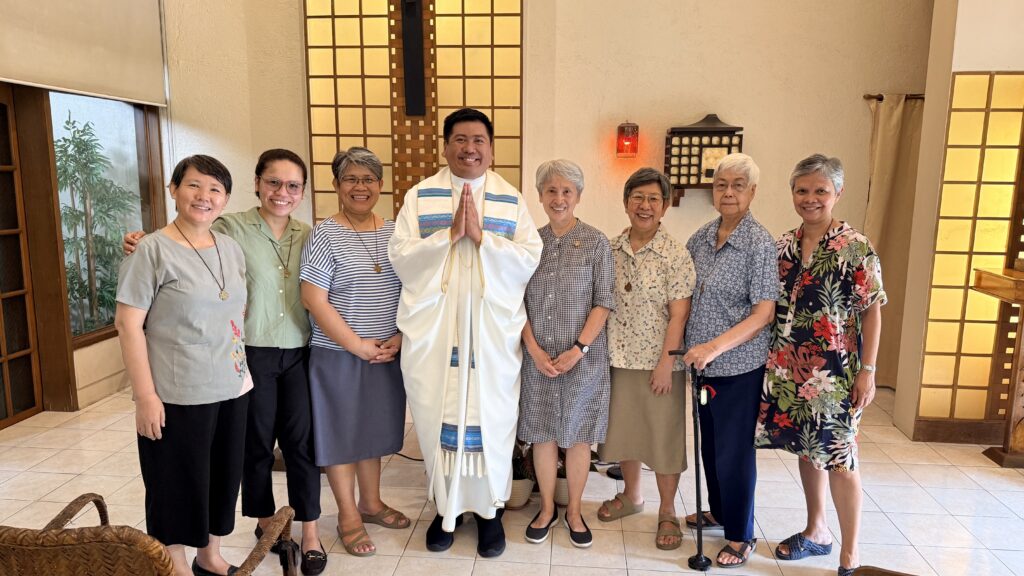
Memorial of the Immaculate Heart of Mary Homily delivered by Fr. James Santos, SJ 13 June 2026; Memorial of the Immaculate Heart of MaryCenacle Retreat House My dear Sisters, As I prayed over today’s Gospel, I found myself returning to a very personal moment in my life during my novitiate, particularly during my 30-day Spiritual Exercises retreat. It was already the eighth day of silence, prayer, and contemplation. Instead of experiencing peace, I found myself in struggle. I was wrestling with my sense of unworthiness before God. Pakiramdam ko, hindi ako makausad…I felt like I could not move forward. In the silence of those days, I was confronted by my own weaknesses, my wounds, my grief, my compulsions, and sins. Slowly, a painful question began to form in my heart: whether I was truly called to this life, if i’m ready and whether I could really live as a Jesuit given my brokenness. There was even a moment when I feared that I would not be able to finish the retreat. Because during break day, i found out that two of my co-novices left so all the more did I feel sad. Then came the ninth day. After breakfast, I returned to my place of prayer still carrying that heaviness. I had just begun to settle into silence when I heard music coming from the nearby dining hall. It was the song “Huwag Kang Mangamba” a Jesuit song that my parents deeply loved.Huwag kang mangamba, ‘di ka nag-iisaSasamahan kita, saan man magpuntaIka’y mahalaga sa ‘King mga mataMinamahal kita, minamahal kita…..Tinawag kita sa ‘yong pangalanIkaw ay Akin magpakailanmanAko ang Panginoon mo at DiyosTagapagligtas mo at Tagatubos….Sa tubig kita’y sasagipin (dito nagbreak down na ko…)Sa apoy ililigtas man dinAko ang Panginoon mo at DiyosTagapagligtas mo at Tagatubos And in that moment, something unexpected happened within me. It was only the beginning of the song, just the first few notes, but I suddenly found myself in tears. Hindi pa nga umaabot sa chorus, humahagulgol na ako. I could not explain it then, but in that sacred silence, I experienced something very real and very personal: a deep assurance that the Lord was speaking to me. Not in words, but in love. It was as if the Lord was saying quietly in my heart, ā€œJames, mahal kita e” And I found myself weeping, not out of fear anymore, but because I was being loved in a way I did not deserve and could not fully comprehend. The experience was overwhelming, not because it was dramatic, but because it was so personal and so tender. It felt as if my heart was being filled beyond its capacity…so full of love that it could no longer contain it. Yung tipong sinisiksik…pinupuno ung puso mo ng pagmamahal pero hindi mo makaya kasi hindi ako sanay tumanggap ng ganung klaseng pagmamahal…..pero sinasabi Nya tanggapin mo lang…. In that moment, I realized that the Lord was not demanding anything from me. He was simply loving me..freely, completely, without condition. Walang hinihinging kapalit. And strangely, it became very difficult to resist that love. Earlier in the retreat, I also remember a contemplation on sin where I saw only the wounded feet of Jesus on the cross. Everything else was dark, but I felt drawn to those feet. I found myself simply staying there in prayer, gently touching the wounds of Christ, contemplating His tired and bruised humanity. At that time, I did not understand what that meant. But after that experience during the song, it became clear to me that Jesus was revealing something very simple and very profound: that His love reaches even into my wounds, and that nothing in my brokenness can separate me from Him. My wounds and His wounds were not barriers, but places of encounter. Looking back, I realized that what I experienced in those moments was not just consolation. It was a deep and abiding assurance that I am loved by God, not because I am worthy, but because He is love. And in that love, I found a freedom that I could not easily refuse. When I shared this with my novice master, I remember saying to him, ā€œFather, noong mismong panahong iyon, parang ang hirap-hirap hindian ng pagmamahal ng Diyos.ā€ At that moment, I realized that God was not forcing me to follow Him. He was simply loving me into freedom. That experience did not end in the novitiate. It has remained with me and continues to shape my understanding of vocation, community, and prayer. It also deepened my devotion to Mary and the Eucharist, because I began to understand more deeply how faith is lived not in clarity, but in trust; not in control, but in surrender. I feel this is what Mary teaches. Ito ang itinuro sa akin ni Maria: ang manatili kahit hindi nauunawaan, at magtiwala kahit hindi malinaw ang daan. In this light, today’s Gospel becomes very close to the heart. We hear of Mary and Joseph searching for Jesus for three days. We see their anxiety, their confusion, and their love. When they finally find Him in the temple, Mary says, ā€œAnak, why have you done this to us? Your father and I have been looking for you with great anxiety.ā€ These are the words of a mother who loves deeply and who does not fully understand what is happening. This is not a distant or idealized image of Mary, but a very human one. She searches, she worries, she feels the pain of absence. Ito ang puso ni Maria: pusong marunong magmahal kaya marunong ding maghanap, mag-alala, at masaktan. And yet, what makes Mary’s heart the Immaculate Heart is not that she understands everything. It is that she remains faithful even in the midst of mystery. The Gospel tells us that Mary kept all these things in her heart. She holds it, reflects on it, and entrusts it to God. This same Mary is the one we meet in the Cenacle. The same woman who once

Features, General, Soul Food

The path of faithfulness

As we reflect on Mary’s Assumption, heaven as a promise of our eternal home, we remember how this all began with Mary’s Yes at the Annunciation.Ā Mary’s destiny is also our destiny, we are called to say Yes and to follow the path of faithfulness that Mary took: Ā  Is this the way it was — The ageless salvation gift’s announcing Sculpted in a moment of time? Strangely different, touching, haunting, Earthily commonplace, sublimely graced. Ā  She stands — a humble toiler Strong, queenly, poised. Head turned, still with the surprise At the breath of angel voice. Eyes and mouth resolute Yet mellowed warm and with winsome tenderness. Budding breasts revealing her readiness for birth. Ā  Cloak and girdled-gown, their wind-brushed flowing Clasped in a hand that would let No hindrance to the message, Even here where she toils gathering wheat. Feet firmly resting on God’s good earth Yearning in wait for its savior. Ā  A total, human woman: ā€œHow can this be . . . ?ā€ A total, open servant: ā€œBe it done unto me . . . .ā€ Ā  The wait is over And WORD becomes flesh. This Yahweh-woman Stands forever on wheat; Totally His, handmaid and mother, Yet, gift to His people, One of your own. Ā  – The Handmaid by Sr. Maria Corona Crumback, I.H.M. (June 11, 1915 – August 11, 2008) Ā      Ā 

General, Homilies, Soul Food

A Pondering Heart

This homily was given by Fr. Arnel Aquino, SJ, on January 1, 2016, at the Cenacle Retreat House. Early this week, we went on a full ferry boat on our way to Bantayan Island. Across from us sat a mother, and on her lap, a very restless toddler. The little boy was irrepressible. He would squirm out of his mom’s arms, then go onto the floor. There was very little legroom between benches so the little boy wouldn’t notice he was already under the seat in front. Then he would suddenly straighten up and bang his head under the seat, and start to scream. Then his mother would ease him out from under there, put him on her lap. He’d be fine for a while. Then he’d start being antsy again, and start squirming away, and sliding down onto the floor. Same story. Banged his head again, screamed, rescued. This happened around four times through the hour-and-a-half hour trip. I’d have been flustered on the second time that the same thing happened, were I the mother. I’d have tried to, like, ā€œreasonā€ with the baby in some awkward, if stupid way to solve ā€œa problemā€. But this mother, like many mothers—she had her toddler on a very long leash. It was the look on the mother’s face that I found most haunting. It was an unflinching, contemplative look. Not smiling but not frowning either. Not a weak, helpless look, but not a grave, heavy-handed glare either. She was very ā€œthereā€, very present to her baby. Yet, she also looked like she was present to a hundred other things a-swirl in her mind. The best metaphor for her gaze we could borrow from Mary: the look of ā€œpondering these things in her heart.ā€Ā  Many of us are familiar about pondering things in our hearts. We also call it contemplation, don’t we? To ponder contemplatively. And it makes sense that mothers have the forbearance of a Job when they ponder their children in their hearts, because, as we know, unlike the thinking mind, the contemplative heart has a lot more space. Pondering in the heart has plenty of room where our thoughts and considerations can freely drift and dance, without censorship, without analysis, or do’s and don’t’s, or should’s and shouldn’t’s. In fact, one clear sign that we’re pondering with our hearts is when we do not obsess about dichotomies. A contemplating heart has room for contradictions and paradoxes. When our hearts ponder, we’re not cramped by either/or’s, or all-or-nothing’s. A contemplating heart has room for both/and’s, yeses and no’s, should’s as well as shouldn’t’s—and still be at peace. ā€œHay nako, anak,ā€ Mary must’ve pondered as she gazed at Jesus. ā€œHow much you’ve already gone through before you were even born. In the eyes of the world, I’m your dalagang–ina, so you’re an anak sa labas. The angel said you’re the son of God, and savior of the world. But look at your woeful, makeshift nursery, anak.ā€ How much more irony was there for the more fastidious among us to analyze and solve? But in Mary’s pondering heart, there was no contradiction pressing to be straightened, no mistake needing correction. Everything belonged; everything fell into place in that wide space that her pondering heart was. A second clear sign that we’re pondering with our hearts is when love silences fear. When we contemplate with our hearts, love does not erase all fear—for there are things we’re still afraid of when we contemplate about our life. But in a pondering heart, love defangs our fears. It neutralizes its venom. Mary actually had much to fear—before, during, and even after her son’s birth. For one, her womb was growing even before a Joseph showed up at the door; probably why she had to go on self-exile to Elizabeth’s, for fear of being accused of adultery and sentenced to death by stoning. When Mary went on labor, she was far from the welcome of home. Then, no sooner than the child was born, a mad king decreed the massacre of innocents. Oh, there was a lot to fear alright. But Mary’s pondering heart had more space for love than fear. Her love for God far exceeded her fear of men. If ever she was afraid, and I’m sure she was, she never feared for herself alone, which was probably why her world didn’t come crashing down on her. Fear for nobody but ourselves does that to us, remember? It shrinks our world, cramps our space and makes it hard for us to breathe. Kapag natatakot tayo para sa sarili lamang, lalo na dahil pinakamahal natin ang sarili lamang, lumiliit ang mundo natin. A third and final sign of pondering with the heart is that latitude we give for God to move and do whatever he wishes in the space we relinquish to him. It’s like welcoming into your home someone you owe a lot to: you give up your bedroom for him, you leave for him the tastiest portions of the meal, you give him the keys to your house and tell him not to worry about the time of his coming’s and going’s, and that he could wake you up any time if he needs anything, anything at all. That’s the kind of space a contemplative heart has for God, a space of total surrender out of deep respect and gratitude. All her life, Mary welcomed God that way, with a life of constant surrender of her space to whatever God or his son chose to be and to do—even to the way her son chose his death. Pati ā€˜yon, kahit masakit, napagkasya ni Maria sa lawak ng kanyang puso. I imagine that the way Mary contemplated her child is very, very similar to how God contemplates us, from the day he willed our birth, up to now. The divine pondering has unbelievable space for all our contradictions, our inconsistencies, our infidelities. Every inch of God-space is filled with divine love that casts

Scroll to Top