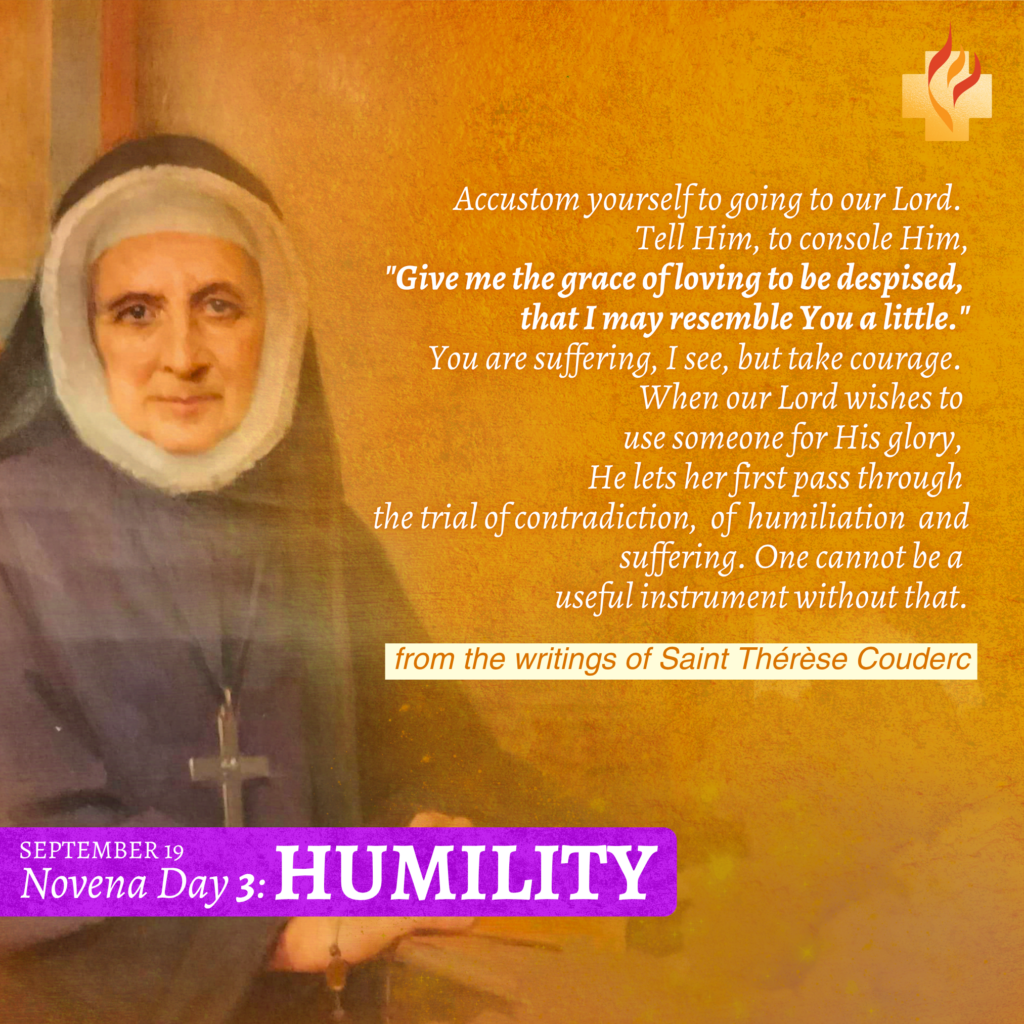
19 September | Novena Day 3: Humility
19 September | Novena Day 3: Humility

19 September | Novena Day 3: Humility
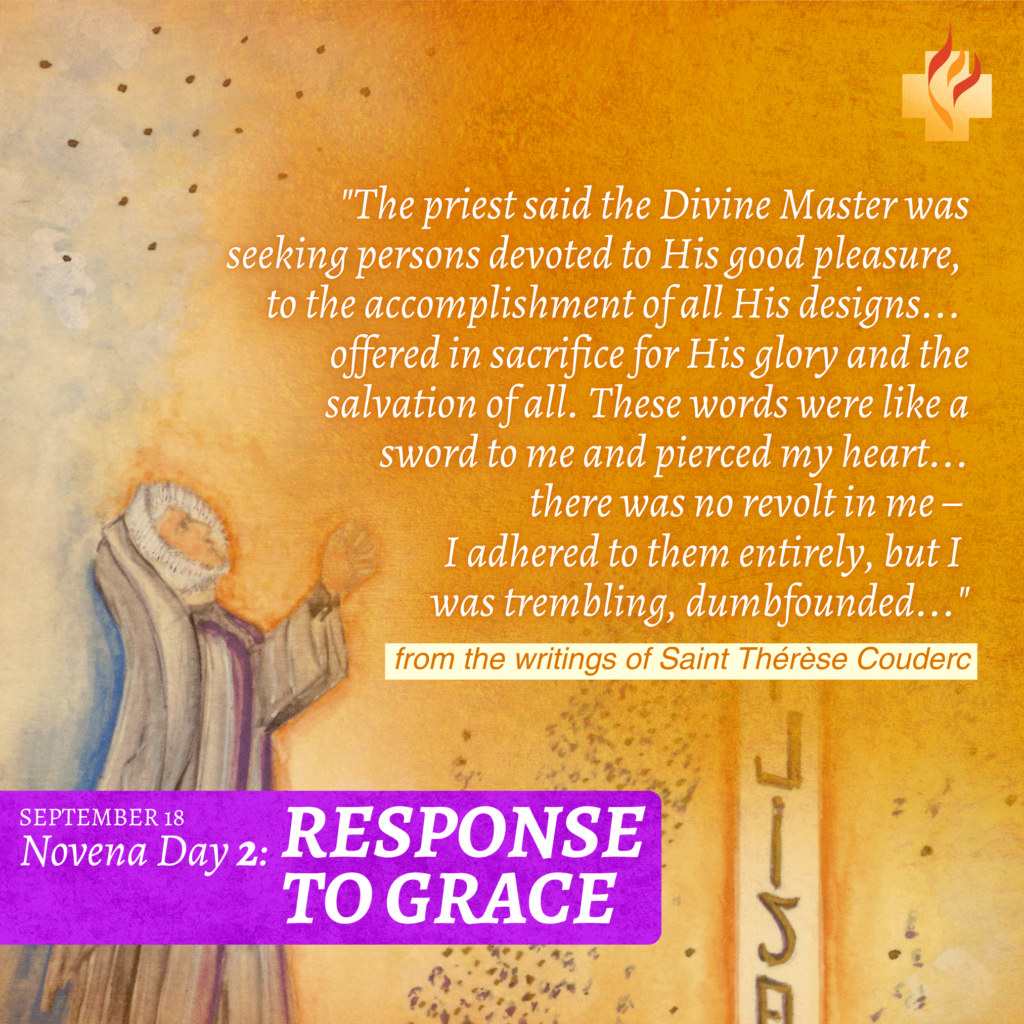
18 September | Novena Day 2: Response to Grace
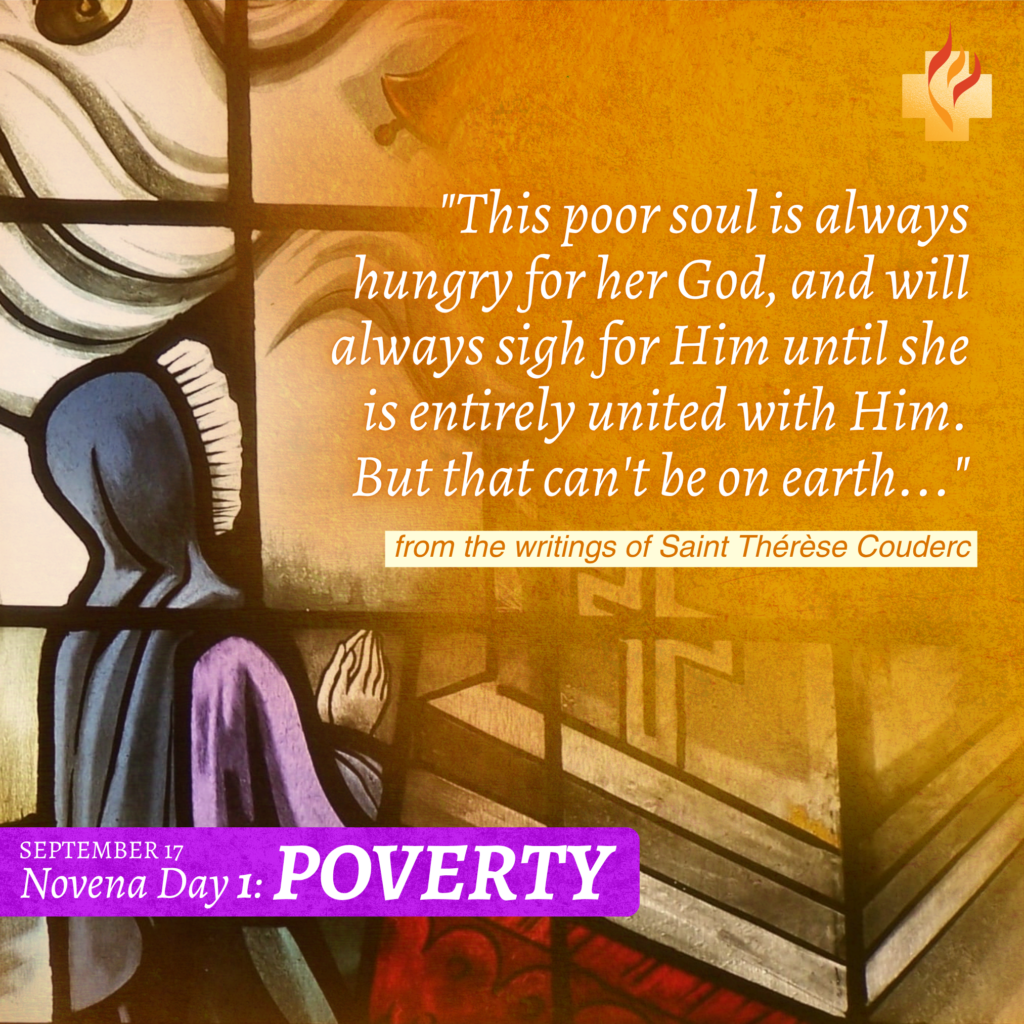
17 September | Novena Day 1: Poverty
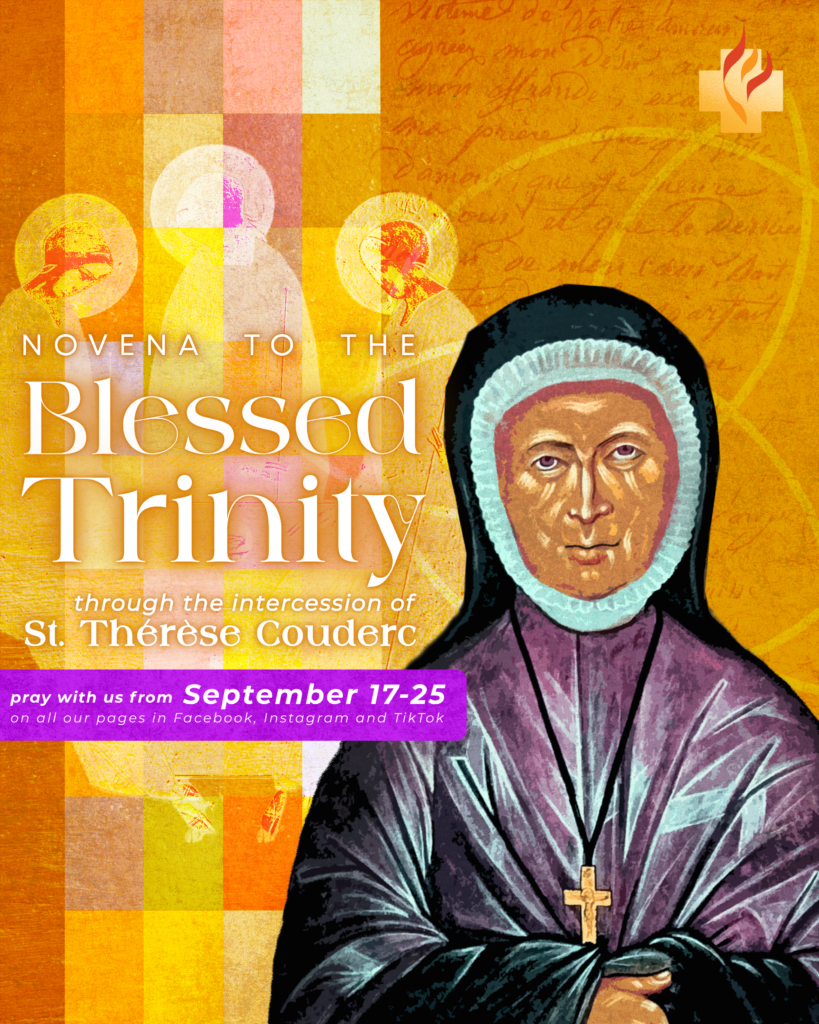
As we prepare for the feast of Saint Thérèse Couderc on September 26, pray with us and discover how her life reminds us that even ordinary moments can be made holy. Each day of the novena, we will also share a photo and a short story from a significant place in her life. And perhaps, we will discover how she speaks to our current realities. Icon from Treasures from the (Cenacle) Archives: https://cenacle1826-2026.org/en/our-founders/portraits/mother-therese-with-a-halo-an-exception/Layout: Josh Velilla
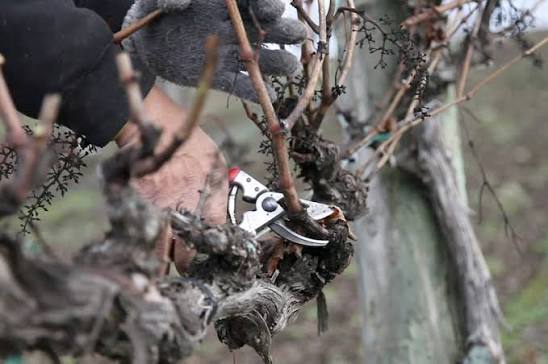
Correction Homily delivered by Fr. Emmanuel “Nono” Alfonso, SJ on Saturday in the 18th Week in Ordinary Time8 August 2026 I used to work with Fr Jack Carroll, the eminent sociologist of the Ateneo de Manila University, at a Jesuit NGO, the Institute on Church and Social issues, which championed the rights of the poor. I was hired as Editor in chief of their publications. My problem though was that my writers, mostly Jesuits, could not meet our deadlines and so a few times the newsletter came out late. One day, we were meeting for another issue of the newsletter. After the brainstorming, he asked me when the issue would be out. Father, I started, God willing. But he held his hand and before I could continue said, in front of the whole group, leave God out of this. And that dear friends was my first taste of Jesuit correction. And I remember this episode in the past because of the Gospel today. Jesus came from his thrilling climb of the Mountain of transfiguration. He must have been tired so when news of the inability of his apostles to heal the son of a desperate father, Jesus exploded. “O faithless and perverse generation, how long will I be with you? How long will I endure you. And later, in a more private setting, he once again berated or rebuked his apostles, you of little faith, if you had faith the size of a mustard seed, blah, blah, blah, blah, blah. Wow! Sounds like someone was in an awfully bad mood. But of course, this was gentler compared to the other times Jesus corrected or scolded them. The worst would have been the time when he chastised Peter in the most hurtful way, telling him, “get behind me, Satan.” Wow. But as we know, Jesus was only human. He could be impatient too over people’s stubbornness or intransigence like all of us. But what is more important though is that he strove to correct his apostles, like a father who confronts his spoiled child. Yes, dear friends, like my Jesuit mentor, God corrects us, God gives us feedback, God straightens us up and we should appreciate that. The famous but sometimes controversial psychiatrist cum philosopher Dr. Jordan Peterson writes that the most critical period in the formation of a child is the first two or three years. The psychotic ones, about two percent of the population, are those who when they were two years old were not dealt with by their parents. When a child shows abusive behavior, they must be corrected right away. In general, he says, the problem with our world is bad or irresponsible parenting, parents who fail to be the adult in the room for their children in their formative years. So, we thank God that in many various ways, he corrects us, or in Jesus’ favorite expression, he prunes us. For our part, we must humbly accept the fact that we are not perfect and need God’s correction always. Once upon a time, there was a priest who was very talented, very bright, very accomplished. He easily rose in the Church hierarchy. And yet as power does to us many times, he became very impatient with the limitations of people. He became arrogant and rude and yet everyone, including fellow priests around him could not give him feedback or correct him. Everyone was simply scared of him. And so he became unreachable, untouchable, and overly powerful. Until one day, when he made a big mistake and crashed. While his friends worried what this failure would do to him, one old priest simply said, This is God reaching out to him and saving him, before it’s too late. Amen.
In the face of evil, Jesus showed the kind of rampage his followers were to do: a rampage of goodness and kindness to the poor; with whatever kulang they could ever part with. Goodness, not despair, open hands, not fists, was Jesus’ response to the empty-handed. And this when he was utterly powerless over his beloved cousin’s bloody death.
Sisters and brothers, it’s okay to go on a quiet rampage…a rampage of goodness, of giving, of channeling God’s grace to the empty-handed. Bahala na si Hesus magparami ng ating kulang na laging kulang. But as I’ve known our brothers & sisters, I can already hear them say, “Ma’m, Ser, wala pong kulang basta meron. Walang kulang, basta biyaya.”
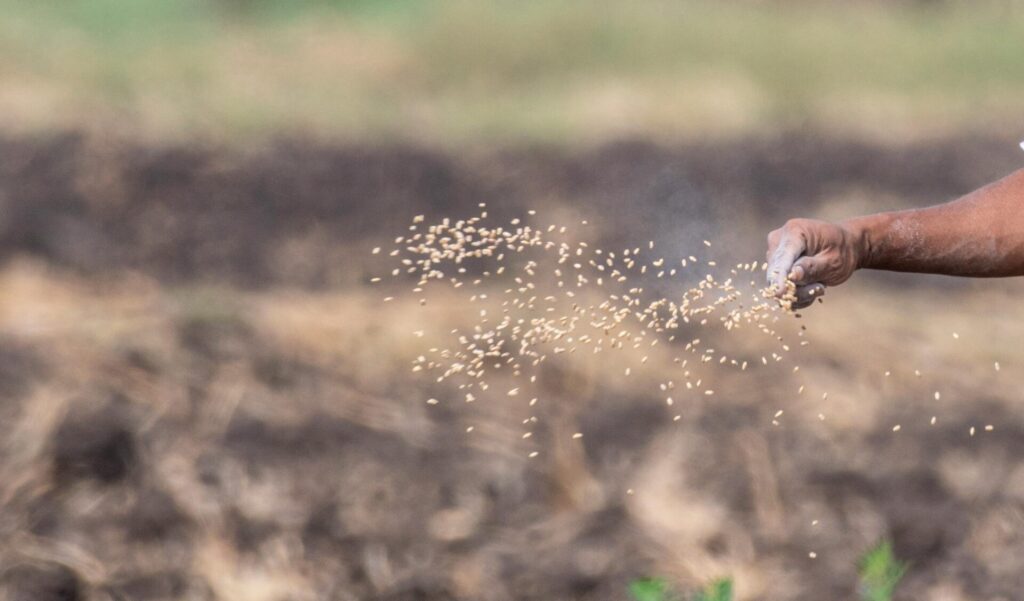
The Sower Homily delivered by Fr. Mamert Mañus, SJ11 July 2026 | Anticipated Sunday Mass | 15th Sunday in Ordinary Time (Isaiah 55:10-11; Psalm 65:10, 1. 12-13, 14: Romans 8:18-23; and Matthew 13:1-23) If there is one thing that unites all four readings today, it is this: God is quietly at work. Not loudly. Not dramatically. Not in ways that always capture our attention, Rather, like rain falling upon the earth. like seeds disappearing into the soil, like a child growing unseen in the womb, God is accomplishing something that we often cannot yet see. That is perhaps one of the hardest lessons of faith. We live in a world that prizes immediate results. We expect instant messages, instant answers, instant success. We measure our efforts by what we can see and count. Yet the kingdom of God follows a very different rhythm. The prophet Isaiah gives us a beautiful image. Rain and snow fall from heaven. They do not return without watering the earth, making it fertile and fruitful. So it is with God’s word. Once God speaks, something begins to happen. We may not notice it immediately. We may even think nothing has changed. But beneath the surface, life is already stirring. The rain never argues with the ground. It simply falls. Quietly. Faithfully. Patiently.So too does the Word of God. Jesus develops that same image in the Gospel. We often hear the Parable of the Sower as a question about ourselves; “Which kind of soil am I?” That is certainly a valid question. But perhaps before asking about the soil, we should first look at the sower. There is something almost surprising about him. He scatters seed everywhere – on the path, among the rocks, into the thorns, and on good soil. Any experienced farmer would probably shake his head. Good seed is precious. Why waste it on places where it cannot possibly grow? Yet Jesus deliberately tells the story this way because he wants us to see something about God. God is astonishingly generous. He does not wait until the soil is perfect before sowing. He does not ration his grace to those who deserve it most. He scatters his Word freely, abundantly, extravagantly, trusting that somewhere, somehow, it will take root. Perhaps that is how God has treated each one of us. None of us came to God because we were already perfect soil. We have all had seasons when our hearts were distracted, wounded, resistant, or crowded by anxiety and fear. Yet God never stopped sowing. He never stopped believing that his grace could still find a place to grow. That is good news-not only for us, but also for anyone who has ever wondered whether their own efforts have been in vain. I imagine that many of our dear Cenacle Sisters know this feeling well, Religious life is, in many ways, a lifetime of sowing. Through prayer, teaching, accompaniment, hospitality, and countless hidden acts of love, seeds have been planted in hearts over many decades. Often, the fruits are never fully seen. Students move on. Families relocate. Ministries change. People forget the names of those who quietly shaped their lives. The same is true for parents, leachers, neighbors, caregivers, and friends. So much of love consists of sowing seeds whose harvest we may never witness. And that can be discouraging. We begin to ask ourselves, “Did anything I did really matter?” Saint Paul speaks directly into that uncertainty. He tells us that al creation is groaning as in labor pains. Notice his image carefully. Labor pains are not signs that life is ending. They are signs that new life is about to begin Paul does not deny the suffering of the world. He knows its hardships well. But he invites us to see them differently. Beneath all the struggles, disappointments, and uncertainties, God is still bringing forth something new. The work of God is often hidden before it becomes visible. That is how seeds grow. That is how rain nourishes the earth. That is how children are formed in the womb. That is how grace transforms a human heart. Perhaps this is also why today’s Psalm overflows with joy. The valleys are clothed with grain. The hills shout for gladness. Everything sings because everything has discovered that fruitfulness ultimately comes from God. Not from our efficiency. Not from our cleverness. But from God’s quiet fidelity. There is a beautiful connection here with the vocation of the Cenacle. The first disciples gathered with Mary in the Upper Room after the Ascension. To anyone looking from the outside, nothing remarkable seemed to be happening. There were no crowds. No miracles. No great achievements. Only a small community praying together in hope. Yet beneath that silence, God was preparing Pentecost. The Upper Room itself became fertile soil. The Cenacle reminds the Church that waiting is not wasted time. Prayer is not inactivity. Hidden fidelity is never fruitless. Some of God’s greatest works begin in places that seem unnoticed by the world. The same is true of our own lives. Some of the most important things happening in your family, your community, your ministry, or even in your own heart may still be invisible. A word of forgiveness. A quiet prayer. A simple act of kindness. A conversation that seemed insignificant. A lifetime of faithful service. These are seeds. We do not always know where they fall, nor how they grow. But God does. Perhaps that is the invitation of today’s readings: not to become obsessed with counting the harvest, but to remain faithful in the sowing. Because the harvest has always belonged to God. I would like to leave you with one final image. When we walk through a forest, we admire the great trees stretching toward the sky. We rarely stop to think about the tiny seeds that disappeared into the earth many years before. Those seeds are no longer visible. They have, in a sense, given themselves away so that life might flourish.
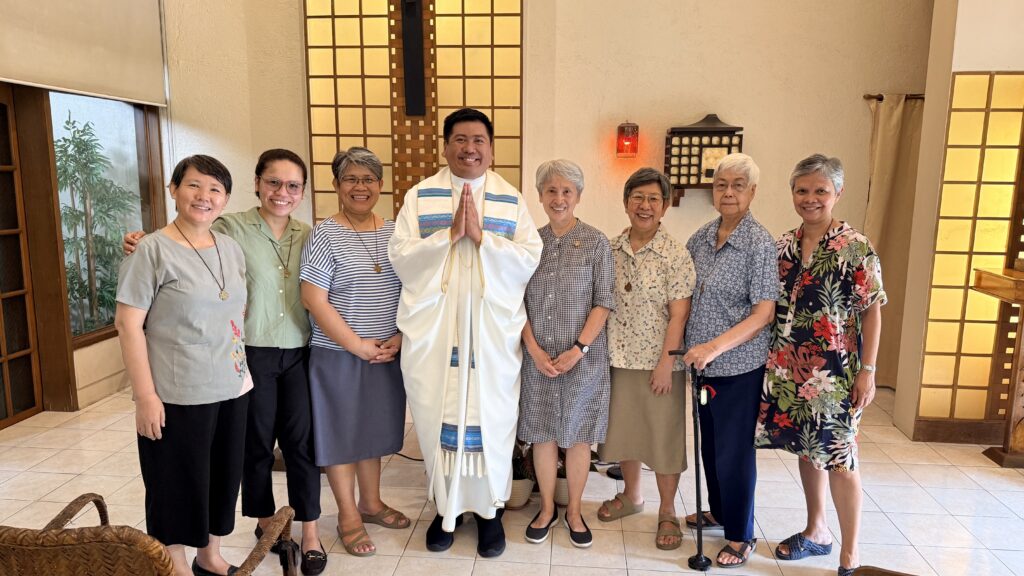
Memorial of the Immaculate Heart of Mary Homily delivered by Fr. James Santos, SJ 13 June 2026; Memorial of the Immaculate Heart of MaryCenacle Retreat House My dear Sisters, As I prayed over today’s Gospel, I found myself returning to a very personal moment in my life during my novitiate, particularly during my 30-day Spiritual Exercises retreat. It was already the eighth day of silence, prayer, and contemplation. Instead of experiencing peace, I found myself in struggle. I was wrestling with my sense of unworthiness before God. Pakiramdam ko, hindi ako makausad…I felt like I could not move forward. In the silence of those days, I was confronted by my own weaknesses, my wounds, my grief, my compulsions, and sins. Slowly, a painful question began to form in my heart: whether I was truly called to this life, if i’m ready and whether I could really live as a Jesuit given my brokenness. There was even a moment when I feared that I would not be able to finish the retreat. Because during break day, i found out that two of my co-novices left so all the more did I feel sad. Then came the ninth day. After breakfast, I returned to my place of prayer still carrying that heaviness. I had just begun to settle into silence when I heard music coming from the nearby dining hall. It was the song “Huwag Kang Mangamba” a Jesuit song that my parents deeply loved.Huwag kang mangamba, ‘di ka nag-iisaSasamahan kita, saan man magpuntaIka’y mahalaga sa ‘King mga mataMinamahal kita, minamahal kita…..Tinawag kita sa ‘yong pangalanIkaw ay Akin magpakailanmanAko ang Panginoon mo at DiyosTagapagligtas mo at Tagatubos….Sa tubig kita’y sasagipin (dito nagbreak down na ko…)Sa apoy ililigtas man dinAko ang Panginoon mo at DiyosTagapagligtas mo at Tagatubos And in that moment, something unexpected happened within me. It was only the beginning of the song, just the first few notes, but I suddenly found myself in tears. Hindi pa nga umaabot sa chorus, humahagulgol na ako. I could not explain it then, but in that sacred silence, I experienced something very real and very personal: a deep assurance that the Lord was speaking to me. Not in words, but in love. It was as if the Lord was saying quietly in my heart, “James, mahal kita e” And I found myself weeping, not out of fear anymore, but because I was being loved in a way I did not deserve and could not fully comprehend. The experience was overwhelming, not because it was dramatic, but because it was so personal and so tender. It felt as if my heart was being filled beyond its capacity…so full of love that it could no longer contain it. Yung tipong sinisiksik…pinupuno ung puso mo ng pagmamahal pero hindi mo makaya kasi hindi ako sanay tumanggap ng ganung klaseng pagmamahal…..pero sinasabi Nya tanggapin mo lang…. In that moment, I realized that the Lord was not demanding anything from me. He was simply loving me..freely, completely, without condition. Walang hinihinging kapalit. And strangely, it became very difficult to resist that love. Earlier in the retreat, I also remember a contemplation on sin where I saw only the wounded feet of Jesus on the cross. Everything else was dark, but I felt drawn to those feet. I found myself simply staying there in prayer, gently touching the wounds of Christ, contemplating His tired and bruised humanity. At that time, I did not understand what that meant. But after that experience during the song, it became clear to me that Jesus was revealing something very simple and very profound: that His love reaches even into my wounds, and that nothing in my brokenness can separate me from Him. My wounds and His wounds were not barriers, but places of encounter. Looking back, I realized that what I experienced in those moments was not just consolation. It was a deep and abiding assurance that I am loved by God, not because I am worthy, but because He is love. And in that love, I found a freedom that I could not easily refuse. When I shared this with my novice master, I remember saying to him, “Father, noong mismong panahong iyon, parang ang hirap-hirap hindian ng pagmamahal ng Diyos.” At that moment, I realized that God was not forcing me to follow Him. He was simply loving me into freedom. That experience did not end in the novitiate. It has remained with me and continues to shape my understanding of vocation, community, and prayer. It also deepened my devotion to Mary and the Eucharist, because I began to understand more deeply how faith is lived not in clarity, but in trust; not in control, but in surrender. I feel this is what Mary teaches. Ito ang itinuro sa akin ni Maria: ang manatili kahit hindi nauunawaan, at magtiwala kahit hindi malinaw ang daan. In this light, today’s Gospel becomes very close to the heart. We hear of Mary and Joseph searching for Jesus for three days. We see their anxiety, their confusion, and their love. When they finally find Him in the temple, Mary says, “Anak, why have you done this to us? Your father and I have been looking for you with great anxiety.” These are the words of a mother who loves deeply and who does not fully understand what is happening. This is not a distant or idealized image of Mary, but a very human one. She searches, she worries, she feels the pain of absence. Ito ang puso ni Maria: pusong marunong magmahal kaya marunong ding maghanap, mag-alala, at masaktan. And yet, what makes Mary’s heart the Immaculate Heart is not that she understands everything. It is that she remains faithful even in the midst of mystery. The Gospel tells us that Mary kept all these things in her heart. She holds it, reflects on it, and entrusts it to God. This same Mary is the one we meet in the Cenacle. The same woman who once
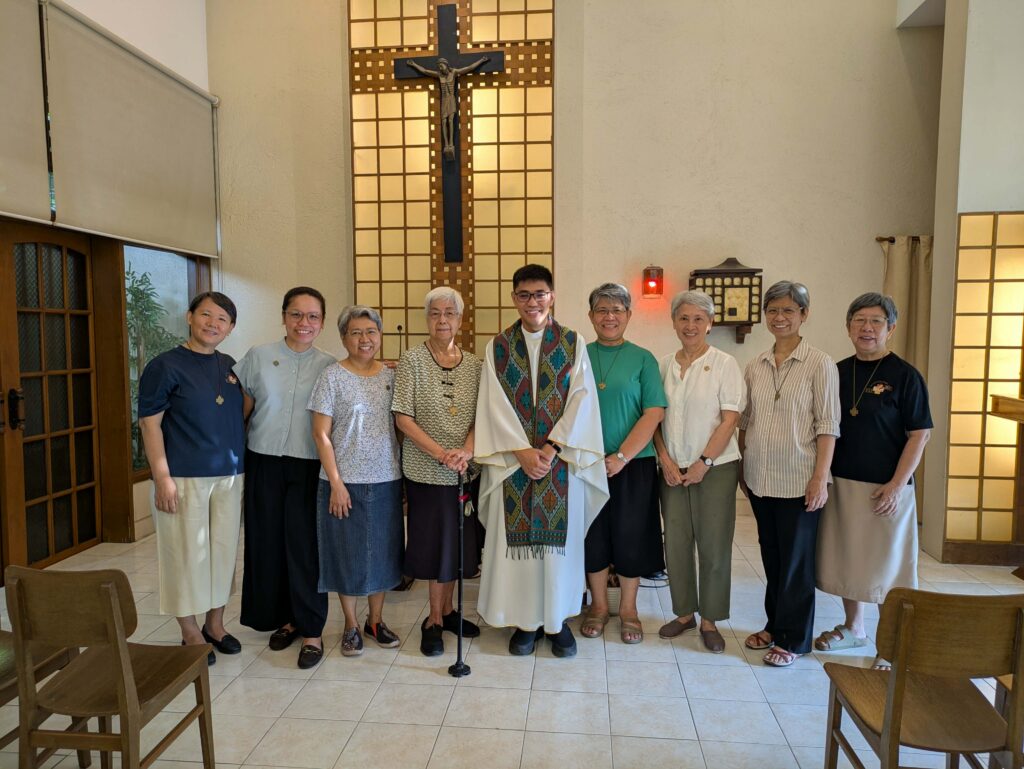
Performative Homily delivered by Fr. Dom Joseph Bulan, SJ 17 June 2026; Wednesday of the 11th Sunday of Ordinary Time Year C (2 Kgs 2:1, 6-4 | Ps 31: 20, 21, 24 | Mt 6:1-6, 16-18)Cenacle Retreat House Have you heard of the term “performative”? For the Baby Boomers and the Gen X here today, chances are this might be your first time to hear this word. But for the millennials, Gen Z, and Gen Alpha, you have probably heard this word, “performative” used at least once, if not several times. Ano nga ba ang kahulugan ng salitang “performative”? Back then, something was considered “performative” when it involves or relates to artistic or theatric performance. So usually, stage actors and actresses, as well as movie stars, would be involved in something performative. But in contemporary times, sa panahon ngayon, the word “performative” has taken on a negative meaning. To be labeled as “performative” means to say or do something to make oneself look good, righteous, or virtuous to an audience. Sa Filipino, may salita rin tayo para rito – “pakitang-tao”. (Mas masakit yatang pakinggan kapag nasa wikang atin). Ang pagpapakitang-tao at ang pagiging “performative” ang nais tumbukin ni Hesus sa ating Ebanghelyo ngayon. In our Gospel today, Jesus warns his disciples about being hypocrites, of doing things merely for show. He says, “When you give alms, do not blow a trumpet before you, as the hypocrites do.” He likewise tells them, “When you pray, do not stand on street corners so that others may see you.” And regarding fasting, he warns them not to put on gloomy faces just to broadcast their sacrifice. In all these, Jesus is pointing to the same temptation: to turn acts that should be directed towards God into performances directed towards an audience. Instead of worshipping God, one begins to worship the approval and admiration of others. Dear sisters and brothers, within each of us is a temptation to be a “performer” or to be “performative”. We see this in school, whenever a student studies or volunteers for a project, not because it is the right thing to do, but because it will look good on a résumé or impress a teacher. We also see it in the workplace, when someone takes credit for a team’s accomplishment, meticulously crafting an image of competence and success while hiding mistakes and weaknesses. The temptation is not simply to do good, but to be seen doing good. And yes, this temptation also happens to us priests and religious. Kahit kaming mga pari at mga relihiyoso, natutukso ring magsalita at kumilos upang magmkuhang mabait, katanggap-tanggap, at kapuri-puri sa iba – ika nga ng mga mas nakababata, maging mga cloutchasers. And if I daresay, this temptation is stronger for men and women of the Church. After all, our ministry is public. Here, it becomes very easy to confuse serving God with managing our image before others. Minsan, mas nagiging mahalaga pa ang papuri ng tao kaysa sa katapatan sa Diyos. Minsan, mas nagiging abala pa sa kung ano ang sasabihin ng iba kaysa sa kung ano ang hinihingi ng Panginoon. At minsan, maaari ring mangyari na ginagawa ang tama, ngunit para sa maling dahilan. There may be many reasons why we fall into the trap of being “performative”, but I believe one of them is a deep insecurity about one’s own sense of goodness and self-worth. ‘Yung tipong dahil sa palagay mo, hindi ka mabuting tao, o hindi ka kamahal-mahal, o hindi ka worth it, kaya sinisikap mong gawin ang lahat para magmukhang ganoon. But if there’s anything our Lord reminds us time and again, it is this – we do not have to “perform” in front of him; we do not always have to prove that we are worth his love, his affection, his mercy. We do not say good things or do good things to chase clout from the heavens. Hindi tayo nagsasabi at gumagawa ng mabuti para makapuntos sa Diyos. No. As the recent solemnity of the Sacred Heart of Jesus has reminded us, our God is a God of love, and this love has been freely offered to all of us – independent of our worth, of our past, of what we have said and done. Instead, we intentionally choose to do what is right and just as a participation in the goodness and righteousness of God who first loved us. So, the next time you are tempted to be “performative”, sa susunod na pagkakataong matutuksong “magpakitang-tao”, ask yourself: “If no one were watching me right now, would I still choose to do this?” And perhaps a second question: “Am I doing this because I love God and neighbor, or because I love the praise and approval that may come from them?” As we continue with our Eucharist, we beg for the grace of sincerity and integrity of heart. May the Lord free us from the need to constantly perform before himself and others. And may he teach us to do what is good, not for recognition or reward, but simply because we have first experienced the goodness of the God who sees in secret and loves us all the same. Amen.
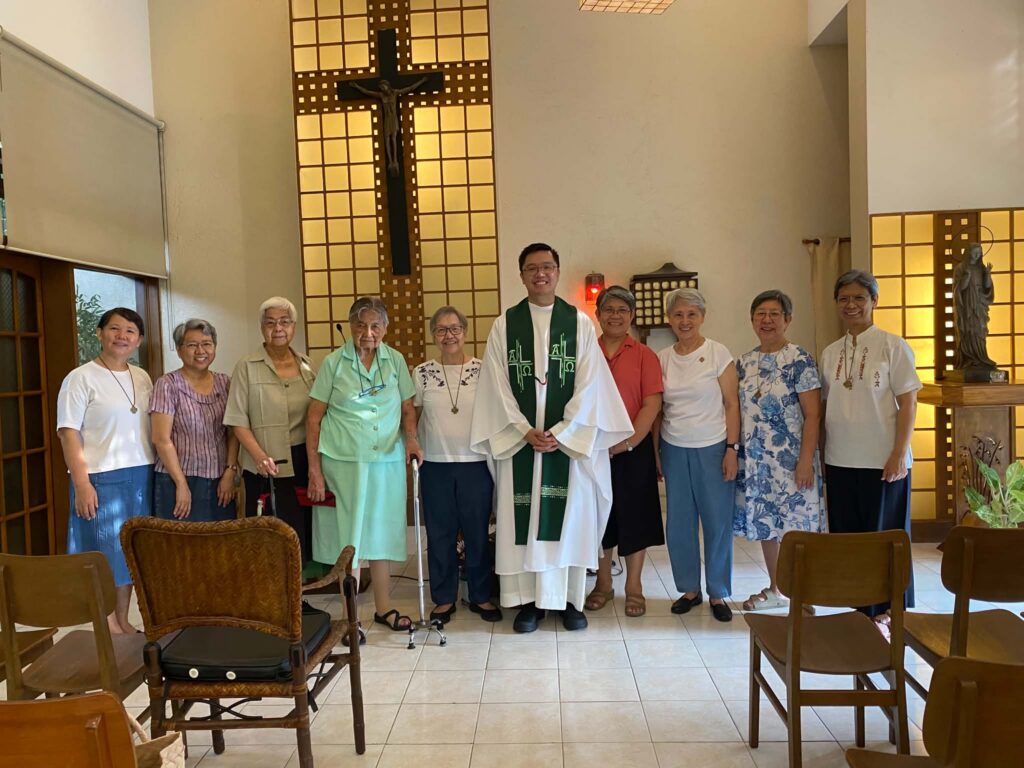
Freedom in Surrender Homily delivered by Fr. Bien Emmanuel C. Cruz, SJ 15 June 2026; Monday of the 11th Sunday of Ordinary Time (1 Kings 21:1-16 and Matthew 5:38-42)Cenacle Retreat House My dear brothers and sisters, the Word of God today presents two sharply contrasting visions of the human heart. In the first reading, we encounter King Ahab, who sees Naboth’s vineyard and desires it for himself. He is not in need, yet what belongs to another awakens a desire that quickly becomes entitlement. When Naboth refuses—faithful to his inheritance and to the law of God—Ahab does not accept limitation. His desire turns into resentment, and resentment opens the door to injustice. What begins as wanting ends in the violent taking of what was never his to claim. This is more than an ancient political story. It is a revelation of the human heart when it forgets God. It is what happens when desire is no longer shaped by gratitude, when power is no longer guided by responsibility, and when possession is no longer restrained by moral limits. It is the logic of grasping: if I want it, I should have it; if I can take it, it is mine. In the Gospel, Jesus presents a radically different horizon. “Turn the other cheek.” “Give to the one who asks of you.” These are not calls to passivity or weakness. They reveal a deeper strength—the freedom of one who is no longer ruled by the need to dominate, retaliate, or control outcomes. The disciple of Christ is not powerless, but free: free from revenge, free from the anxiety of possession, free from the need to settle every wrong by force or repayment. Both readings place before us a fundamental question: what kind of person are we becoming in the face of desire and injury? Do we become like Ahab—consumed by what we lack and willing to overstep moral boundaries to obtain it? Or do we become like the disciple Jesus envisions—rooted in trust, capable of generosity, and free enough to step outside the cycle of grasping and retaliation? The world teaches a different grammar. It tells us that life is secured through accumulation: more possessions, more achievements, more control over the future. It tells us that relationships are governed by exchange: I give so that I may receive, I help so that I may be helped, I forgive if it is deserved. It is a world of balance sheets and measured reciprocity. But the Gospel quietly disrupts this entire logic. Jesus reveals a life where love is not calculated, forgiveness is not conditional, and generosity is not measured. This is not irresponsibility. It is a deeper freedom grounded in trust in God. Here we meet one of the deepest paradoxes of the spiritual life: to be full, we must first be emptied. We often think fulfillment comes from holding more tightly, securing more guarantees, and controlling more of life. Yet the Gospel—and the experience of faith—reveals the opposite. God fills not what is full, but what is open. This emptiness is not nothingness. It is not despair or loss of identity. It is surrender. It is the interior act of releasing our grip on what we thought we needed so that God may give what we truly need. We surrender our plans, not because planning is wrong, but because our plans are often too small for what God is doing. We surrender our expectations, not because hope is futile, but because God’s generosity exceeds imagination. We surrender control, not because life is chaotic, but because providence is deeper than our calculations. As long as our hands are clenched around our own desires, there is little space for grace. But when we open them—even in uncertainty—we discover that what felt like loss becomes the very place of receiving. This is not only a theological idea; it is also a lived experience. Recently, I received my first pastoral assignment as a priest. I was assigned as Assistant Parish Priest in a small mission parish in the mountains of Bukidnon under the Jesuit missions. It came unexpectedly, without warning or preparation. None of the plans I had quietly formed seemed to apply anymore. At first, there was disorientation. What I thought would be my path suddenly shifted. It felt like something had been taken away. But in time, what seemed like interruption revealed itself as invitation. What felt like loss became the beginning of something deeper. I can now only see it with gratitude: God did not follow my plans; He led me beyond them. There, I began to understand more clearly that God is not competing with our control. He is not waiting for us to get everything right before He acts. Rather, He draws us into His wisdom, often by loosening our grip on our own. What feels like uncertainty can become the beginning of true freedom. It became an opportunity to surrender. And in that surrender, I learned something essential: God does not fill what is already full. He fills what is empty. He does not work on the logic of exchange or “quid pro quo.” His generosity is not transactional. It is overflowing, excessive, and beyond calculation. God is never outdone in generosity. Every gift we offer has already been preceded by His gift. Every act of love is a response to a love that came first. Every surrender is met not with deprivation, but with deeper life. God does not simply return what we give; He transforms it and multiplies it. Seen in this light, Ahab’s tragedy becomes clearer. He cannot accept limits because he does not trust abundance. He believes what he lacks must be taken, because he does not believe it will be given. His grasping becomes his prison. Jesus, on the other hand, reveals the path to true freedom: not the freedom to take what we want, but the freedom to release what we cannot control; not the freedom of possession, but the freedom of